There’s this great tweet by @nosilverv in which he outlines a “jumping” mechanism that happens in consciousness, where a new type of Thing is exposed to you and suddenly another dimension of reality is opened up.
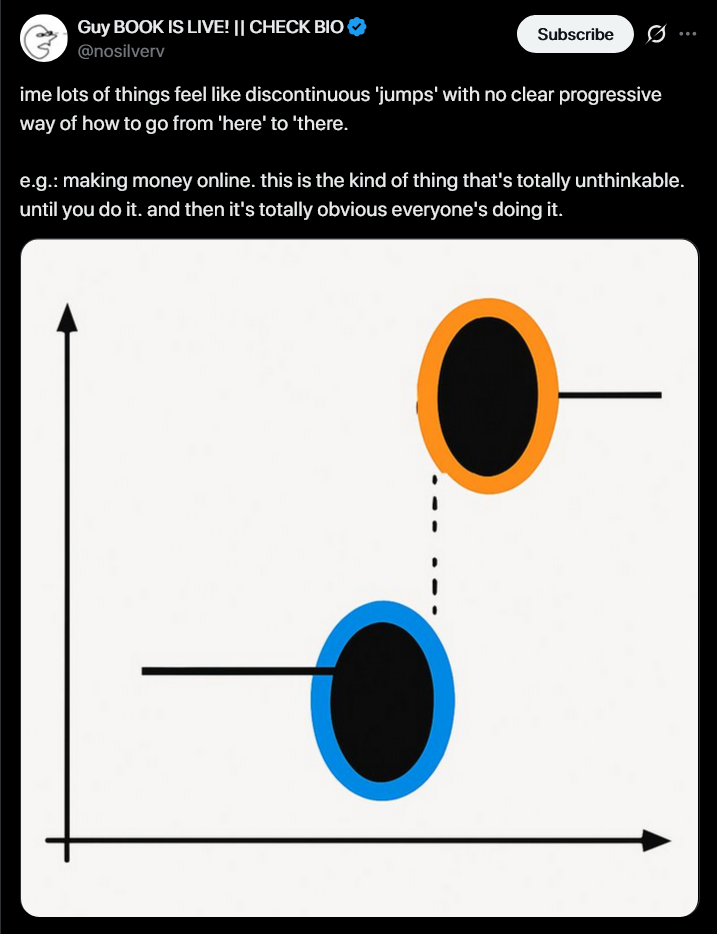
This tweet made me realize something important related to jumps in epistemology: what you best learn from others is about processes, not content. Content is simply a semantic pointer to the process. When you have learned from someone or something, what you are picking up on is the way in which you think about something, not the thing you think.
When learning from others, the realizations typically happen in a manner of “wait, I can think that way?” or “wait, I can construct reality like that?” The realizations happen in the realm of the Why/How, not the What. The What (the words) is a simple helper function that points to a deeper process that is actually the useful thing.
Sure, content is somewhat important. If you have to remember something quickly for a test, just studying flashcards and memorizing the content can be helpful. But it’s not really going to deeply affect your epistemological landscape the way actually understanding the content would. By understanding, I mean a deep felt sense of the scaffolding and architecture of the problem space.
It’s hard for me to remember the exact content of people who have deeply affected my thinking, but I think that’s the point. As I introspect deeper, it’s clear my biggest influences have surrounded how I think and the whys behind my thinking, not necessarily the what. The hows and whys generate the whats, but the whats also inform the other two through bidirectional feedback loops. My greatest influences have given me deep structural principles and ways of looking at the world through contemplation of content, not just content by itself.
Henrik Karlsson says something similar in his essay Be Patient with Problems:
When you go deep, probing the assumptions, looking from multiple angles, and reformulating things in your own words, the ideas become part of you. This is one of the reasons why I write. When I unpack things fully, the ideas become objects that I can rotate in my mind. The subconscious can draw parallels that it can't if the ideas haven't been thoroughly unpacked.
What he’s pointing to is deeper than just internalizing what someone said or how a thing is. It’s looking at the thing from a deeper lens, with a kind of respect and admiration for the thing, instead of just throwing it away.
This all reminds me of the Whole Word Method versus Phonics for teaching reading. If you don’t know, the Whole Word Method is essentially just memorization of how words look and matching the word to a sound. But phonics is a bottom-up method of assigning sounds to letters. In this scenario, the Whole Word Method is the What, and phonics is the Why and How. The Whole Word Method can be useful as a support mechanism, but generally research supports phonics much more as an effective approach. See where I’m going with this? Content can be useful as a pointing-out instruction, but generally processes are better to learn from.
This is why using LLMs to generate content without engaging your own hows or whys is extremely dangerous. If you offload your processes, the content will soon be discontinued through degradation of your own brain. Use LLMs to increase the quality and frequency of your cognitive effort, not replace it. The one thing to avoid is simply passively reading LLM output and moving on. You’ll accumulate a feeling of understanding without the actual structural model that produces real understanding. You’ll have the What without the Hows or Whys.
I find that every problem space I encounter has a set of fundamentals and first principles that make it much easier to solve if I know them. I believe this also applies to learning from others. Every time I’m learning from someone, whether through a blog post or YouTube video, they are operating from a set of fundamentals that are the generators of the content they are putting in public. And if I can identify those fundamentals, I can perhaps uncover content they have not discovered due to my own unique experiences.
I’m reminded of this Oscar Wilde quote:
If you cannot write well, you cannot think well; if you cannot think well, others will do your thinking for you.
Writing is an act of exposure. This is what Feynman knew when he would reorganize his knowledge around subjects based on what he did not know. Writing is an act of exposure by meeting with reality about your processes, and it is kind enough to give you feedback. Luckily, this feedback of ignorance can be used wisely through attempts at learning and understanding by going deeper and deeper until you feel you’ve reached the bottom of your current epistemic landscape.