I’ve been going through the book ‘How To Solve It: A New Aspect of Mathematical Method’ by George Pólya recently and thought I would write about some of it. I first came to know of this book a few months back and ever since I first glanced at it I knew it was something special, something that would renew my faith in my ability to solve problems that tested me. The crux of the book surrounds mathematics and its different properties such as its rigorous scientific approach and its intuitive side. However, it’s quite clear the processes Pólya outlines can be used in a lot of domains, and for problem solving in general. The heuristics and mental operations listed are not constrained by the domain of mathematics which I am quite fond of. I think it is a good signal that Pólya can devise methodologies that are not constrained by the ever-so-formal mathematical approach.
The book really surrounds a 4 phase plan: understanding the problem, devising a plan, executing the plan, and looking back. All 4 phases have their unique attributes that use their own heuristics to tackle problems in an effective and satisfying manner. Each phase is very purposeful and it’s clear Pólya has a lot of tacit knowledge in this domain. For example, take this quote: “The worst may happen if the student embarks upon computations or constructions without having understood the problem. It is generally useless to carry out details without having seen the main connection, or having made a sort of plan. Many mistakes can be avoided if, carrying out his plan, the student checks each step. Some of the best effects may be lost if the student fails to reexamine and to reconsider the completed solution.” He explains why each phase is purposeful based on his own experience and wisdom as an educator. His tacit understanding explicitly states that problem solving is not just about finding the final solution, but rather about the disciplined mental operations required to think through things on your own, which protects you from wasting time.
Another thing I enjoy about the book is that the ideas are simple and seem like common sense. Pólya does not attempt to converge on complex frameworks that you must take 10 minutes to setup. Rather, his insights only take a little bit of practice to understand and once you understand them, it’s clear these heuristics are common sense. This common sense however has just been bogged down by many years of being persuaded that complex thinking is the solution and we should spend hours of our time on useless steps. Now, obviously some problems are so nuanced and complex hours of time is needed, but with the methodologies Pólya proposes, that time is better well-spent on actually getting to the crux of the thing.
I like to think a lot of the methodologies he lists are common sense considering they can be condensed into modular heuristics like “what is the unknown” or “do you know a related problem.” These heuristics are designed to act as a guide for the student to really understand the problem. He says without first deeply understanding the thing, we are destined to waste time. I’ve found this true: when solving for software or design problems, it is crucial for me to develop a strong mental representation of the thing before I tinker with it, otherwise I’m in for a time of battling my own intuition. In fact, I think Pólya has some great ideas about mental models here. One of the first parts of his process is visualizing the problem as a whole from a high-level overview without getting bogged down in the details: “Visualize the problem as a whole as clearly and as vividly as you can. Do not concern yourself with details for the moment. What can [you] gain by doing so? You should understand the problem, familiarize yourself with it, impress its purpose on your mind. The attention bestowed on the problem may also stimulate your memory and prepare for the recollection of relevant points.” His essential point is that by building this first high level overview and mental model of the problem— we give ourselves the ability to mobilize and organize past knowledge we hold in our system. By moving this info around, we can finally bring the needed knowledge and skills to the forefront of our attentional capacity, bringing us closer to solving the problem.
I think the phenomenology of this is super interesting. I’ve been exploring lately the topic of mental representations and how important they are to our experience of understanding the world. One very common sentiment that’s come up in my personal research is that model-like structures live in the body as felt senses. We can often come up with mental images that have a felt trace of resonance, a type of felt sense that tells you if the representation is accurate towards your Being. By Being, I mean our conditioning, our genetics, our biology, what makes you, you, and what makes me, me. For example, take this quote by Grothendieck: “What drives and dominates my work, its soul and reason for being, are the mental images formed during the course of the work to apprehend the reality of mathematical things.. All my life I’ve been unable to read a mathematical text, however trivial or simple it may be, unless I’m able to give this text a ‘meaning’ in terms of my experience of mathematical things, that is unless the text arouses in me mental images, intuitions that will give it life.” I don’t want to trivialize this quote and just compress it down to something like “just use your imagination like Grothendieck and you too can be a world-class genius!” But rather, it’s important to recognize the underlying common heuristic we can extract from his amazing mind: we can give problems meaning by finding resonant mental representations, and this meaning is important for finding motivation to solve the problem and to deeply understand it. As Pólya says: “Yet it is not enough to understand the problem, we must also desire its solution. We have no chance to solve a difficult problem without a strong desire to solve it, but with such desire there is a chance. Where there is a will there is a way.” By giving the problem itself meaning through resonant mental representations, we allow ourselves to become moved by the innate aliveness of the task at hand, which carries attention in a much more willful manner.
Coming off that, being motivated to understand and solve a problem causes us to have a greater chance at mobilizing and organizing important knowledge. What does this mean? Pólya defines mobilizing as “Extracting such relevant elements from our memory” and organizing as “This adapting and combining activity” (which he further describes as the need to “construct an argument connecting the materials recollected to a well adapted whole”). These are the core mental operations that move us towards finding solution to problems. Really, most other methodologies he lists are in service towards these operations as they are the steps that move us forward. As we move through a problem, our relationship with it and our dormant knowledge unfolds through a seemingly evolutionary force. As you actively use relevant knowledge to solve a problem, your understanding becomes clearer, which might eventually lead to an intuition that takes you down the final path of finding the solution. Moving with these intuitions always forces us to updated our understanding of the problem. However, Pólya makes it clear we must have desire to solve the problem for these steps to even be relevant. “Yet understanding alone is not enough; he must concentrate upon the problem, he must desire earnestly to obtain its solution. If he cannot summon up real desire for solving the problem he would do better to leave it alone.” He says this because a lot of problems require intense, sustained concentration. Through sustained attention on the problem, we can effectively mobilize knowledge that may remain dormant if we choose to become distracted. As a metaphor, there may be some dormant knowledge that is being covered by dust, and it is only with sustained attention that that dust will eventually become blown away and we can finally find the intuitions we need to find the right path for the solution.
It is important to note that just because this sustained attention goes away, this does not mean we cannot find it again. Instead Pólya lays out different heuristics as a method to reengage with the problem to find motivation to continue solving it. Varying the problem or looking at new details can unfold new “untried possibilities of contact” with dormant knowledge. By using the heuristics he lists, we can “reconquer our interest by varying the problem, by showing some new aspect of it.”
Pólya lists 3 useful heuristics we can use to vary problems and find new perspectives of the thing. Linking back to my beginning point of common sense, these heuristics are easy to remember as once again, they are common sense yet not obvious at first. The 3 questions he lists are “what is the unknown?” “What are the data?” And “by what condition is the unknown linked with the data?” And these heuristics all have their own ecosystem of territory you can explore. He finds these questions useful because, “any question is welcome that has some chance of showing a new aspect of the problem; it may reconquer our interest, it may keep us working and thinking.”
Furthermore Pólya lists more methodologies for gaining new perspectives on problems. These include but are not limited to: analogies, auxiliary problems, decomposing and recombining, generalization, specialization, induction, and working backwards. These heuristic operations are used in the first two phases of his approach: understanding the problems and devising a plan. It’s important to note that auxiliary problems are the overarching methodology for phase 2. The key question is, “If you cannot solve the proposed problem try to solve first some related problem”. Every other mental operation in the phase is essentially a method for generating an auxiliary problem. I won’t go deeper into the other heuristics listed as he goes into great detail about each one. For example with generalization, he states: “Generalization is passing from the consideration of one object to the consideration of a set containing that object; or passing from the consideration of a restricted set to that of a more comprehensive set containing the restricted one.” Essentially, he is saying that sometimes passing from a restricted problem to a more comprehensive one actually makes the path clearer because it strips away distracting, overly specific details.
The last point I want to touch on is his idea of subconscious work. He defines this as the involuntary, hidden continuation of the active problem-solving process. This process is characterized by the common experience of struggling with a problem, stepping away, and coming to a solution or intuition when not trying to, such as in the shower or taking a walk. He states a problem can become “essentially clarified, much nearer to its solution than it was when it dropped out of consciousness.” I want to relate this to David Bessis’ book: “Mathematica.” In Mathematica, Bessis states “Our prodigious faculty for learning and invention has its origin in our unconscious ability to constantly reconfigure the fabric of associations of images and sensations that, literally and figuratively, comprise the real structure of our thought” and “It takes time but it’s not a real effort. It’s more like a meditation on running water, something going on in the background that might stop and start, then all of a sudden become clear days, months, or even years later.” It is clear both authors agree something fundamental is happening when we make the effort to take a step away from our work and let the information cook in our minds and bodies a bit. I like to think of it as leaving meat in the fridge sitting in a seasoning or marinade. We are letting the problem-space and our background processes to mix together like a nice recipe that will eventually lead to somewhere unknowable, somewhere nebulous, yet that place brings us somehow closer to the solution. This also brings us back to the point Pólya makes about the important of sustained attention on a problem: without this sustained effort, our background processes cannot effectively “cook” the problem in such a manner that will bring us closer to the solution. Instead if we are constantly pulling ourselves away from the problem, our subconscious has no choice but to ignore the large and maybe stressful entity in front of it.
How I'm Using the Book
I believe this book has been immensely helpful for my problem solving skills. But, this is only possible because of practice and active use of the information. I mean, what would be the use of the book if not actively applied to problems?
In comes LLMs. Essentially, I’ve been using the core Math Academy learning loop of: learn info -> observe a new task being done correctly -> attempt the task on my own -> get feedback -> practice task until mastery. I can do this by prompting it in such a way that uses points of the book, then asking for example problems to apply the heuristics and frameworks to. For example, here’s a screenshot of an output that captures my core flow (but not limited to):
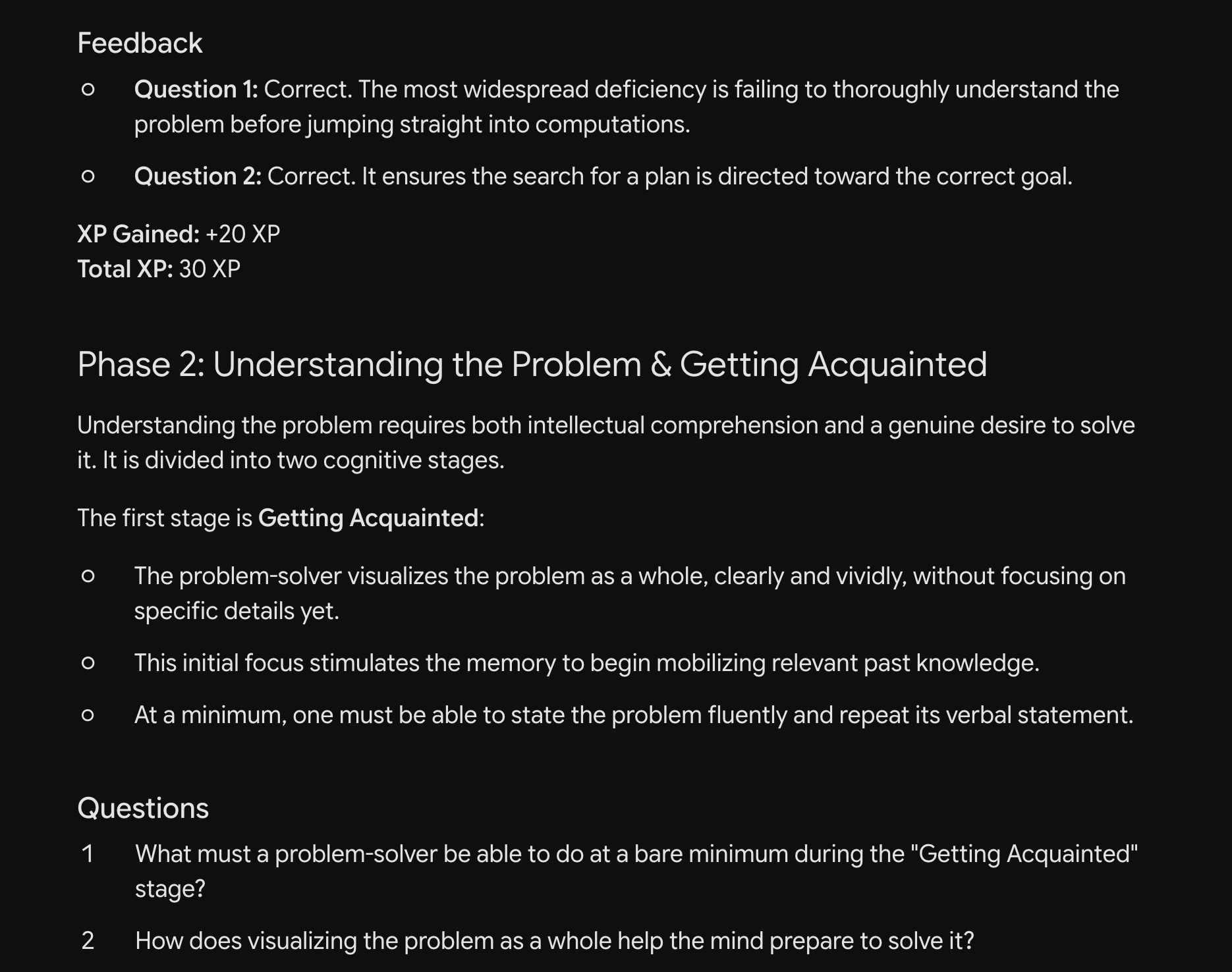
The questions here are quite trivial but they are used to make sure I understand the facts I have just learned and use them in such a manner that allows me to integrate the new info into my system.
And below is a screenshot of a problem-solving workflow, applying what I just learned to more robust example (again, the problem is quite trivial and you can choose to prompt to your own example or level of expertise):
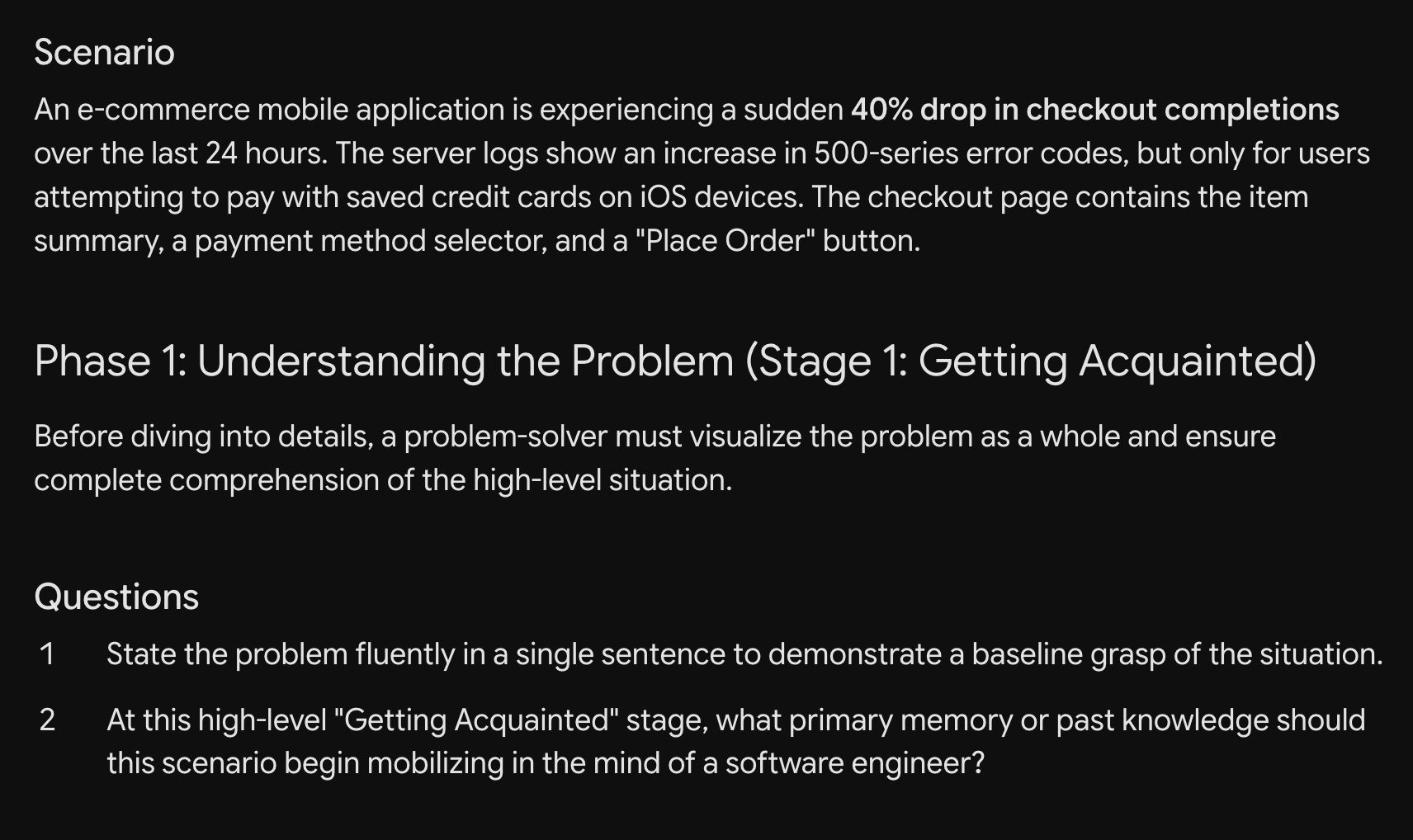
Using these questions and examples, it is quite important to write out your answers as writing is thinking. With multiple choice, you would just be applying top-down reasoning to problems that ask for bottom-up scaffolding which would do you almost no good. As Grothendieck states: “For mathematics, it seems that writing has always been an indispensable means, regardless of who is “doing maths”: doing maths is above all writing. The same is undoubtedly true of any work of discovery in which the intellect plays a major role.” The role of writing in intellectual development cannot be understated, especially when doing something as general as solving problems.
Another way I’ve been using this book is through one key heuristic: to problem solve well, we need to spend concentrated attention on the problem, not distracted by other things that will take us away from our immersive mental models. Henrik Karlsson has this great essay ‘Almost anything you give sustained attention to will begin to loop on itself and bloom’ and in it, he states: “Inversely, the longer we are able to sustain the attention without resolving it and without losing interest, the more time the different systems of the body have to synchronize with each other, and the deeper the experience gets.” I’ve found these reasonings about sustained attention to be overhemingly true. It carries over from meditation too. Really, if you’re going to meditate, it should be at least 30 minutes if you want “good results.” This is because it might take our system at least 20 minutes (ime) to fully come alive and realize its job to focus on the task at hand. If you’re familar with IFS, I like to think of it as my parts coming alive and realizing what their job is which reuslts in a unilateral, wholeness type of attention. The parts fully realize what’s going on and for next {amount of time} minutes/hours, the job is to put their effort on that. All of this has resulted in me pushing myself a little further anytime I want to truly focus on something, “just a little longer” I say. The more sustained attention I put on a thing, the stronger my mental representation of it becomes which results in a deeper understanding of the problem and myself.
Caveats
It is important to recognize where Pólya’s book “fails” or at least does not address some important nuances. For example, what about unknown unknowns? Pólya sort of addresses this by introducing some heuristics like auxiliary unknowns, but all in all they seem to be more proxies for initially finding unknown unknowns, not necessarily addressing or accounting for them. He does not address them as an epistemological category so he does not account for all the nuances the problem that unknown unknowns introduce. It’s also important to point out that any sort of example will not necessarily represent reality accurately or fairly. Pólya agrees with this. He says: “In a perfectly stated mathematical problem all data and all clauses of the condition are essential and must be taken into account. In practical problems we have a multitude of data and conditions; we take into account as many as we can but we are obliged to neglect some… The data of his problem are, strictly speaking, inexhaustible.” When working through examples, we might consider the problem space constrained by our own imagination or whatever an LLM can come up with. Obviously, reality is not like this. Reality is detailed, can be very complex, and unforgivably frustrating. All of the nuances that make up reality are typically outside of our own imagination or immediate experience. It might be said we receive problems better than we do make them. Or maybe there’s not really a difference. Either way, because of these complexities, Pólya notes that in reality, we must frequently rely on approximations and neglect certain details: “We are bound to neglect some minor data and conditions of the practical problem. Therefore it is reasonable to allow some slight inaccuracy in the computations especially when we can gain in simplicity what we lose in accuracy.”
Anyways, I am making my way through the book using this LLM method and I can ensure you that doing something similar will not be a waste of your time. This is one of the most pragmatic and underrated books I’ve found when it comes to this type of thinking (granted I haven’t read much in this domain so forgive my possible ignorance), and I could not recommend it enough.