This is taken from a Twitter thread I posted as a way to share my very rough and undetailed thoughts on how perception, meditation, and Buddhism work together to promote well-being. Don’t expect much detail or nuance as I just wanted a rough outline out there.
we, as bottlenecked humans, compress reality into abstractions to process seemingly ~infinite~ entropy. well-being grows when we use those abstractions flexibly without reifying them.
those abstractions include mental models, language, priors, boundaries, stories, labels, and things. they make ~life possible, but they also create suffering. what’s to be done?
enter computational complexity. reality contains far more interacting detail than a finite mind can comprehend. something can be computable in principle, yet still be impossible to fully model. the brain is an instance of this; it cannot (rn) be reproduced as a formal machine.
every useable model therefore leaves information out. models must be simple enough to use but complex enough to capture what actually matters. i think it is accurate to draw a parallel between ‘computable’, and the mind comprehending something.
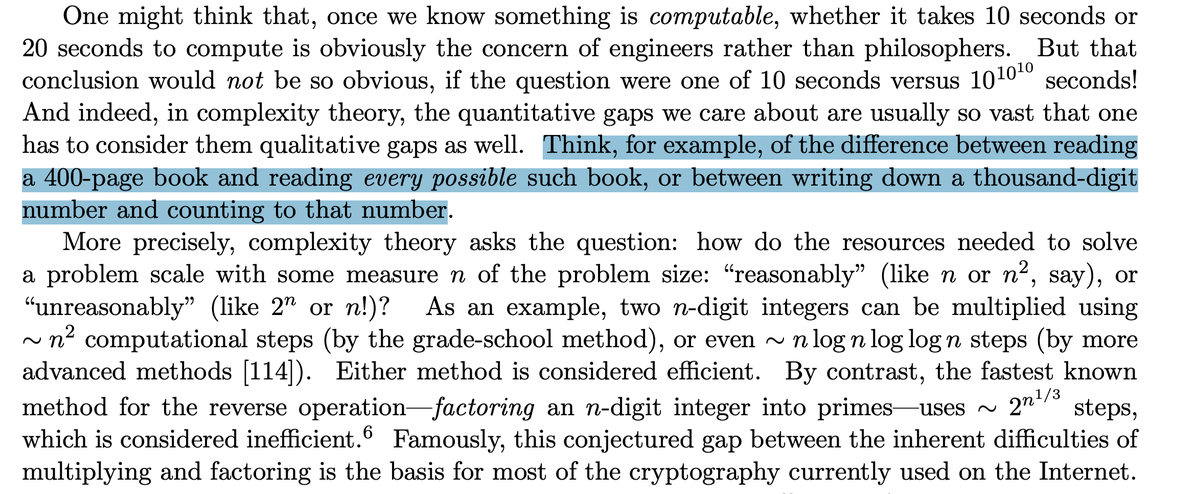
because of this natural stripping of information, we then must decide what exactly do we leave out? the mind must use predictive processing! it compresses past experience into priors, generates guesses about what’s going on, and then sometimes updates those guesses.

computational complexity explains why perception cannot be a full reconstruction of the world, while predictive processing explains the workaround. the mind narrows the search space of reality through things like context and attention. predictive processing is a complex model.
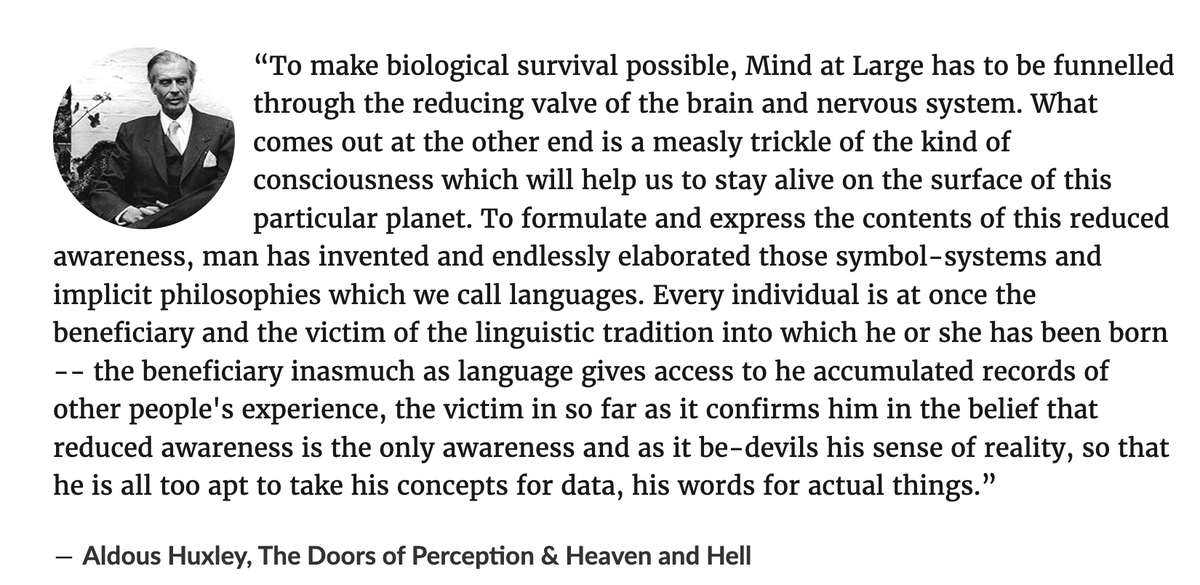
this is also what Huxley was getting at with his reducing valve mechanism:
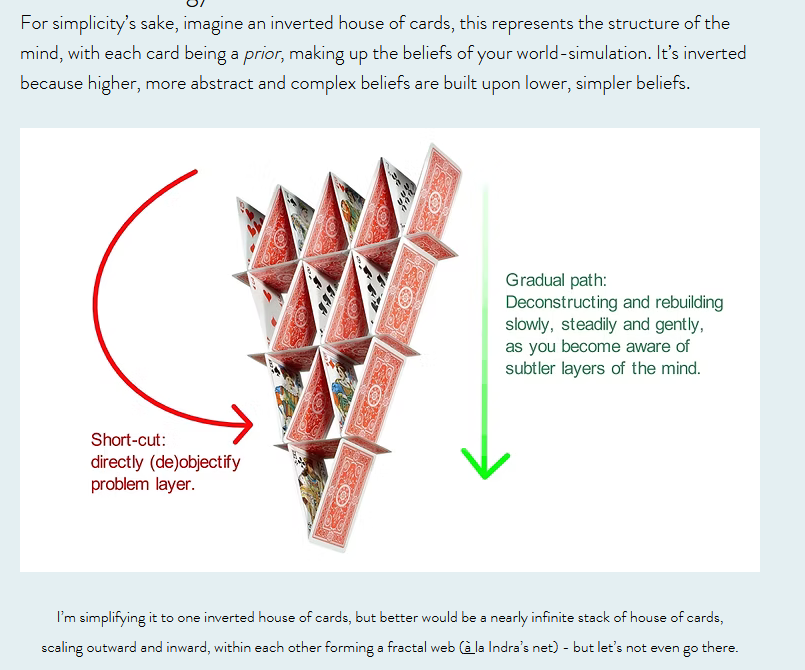
interestingly, we seem to possess a hierarchy of priors. some are built on top of others. for example, the concept of ‘thing’ is a very low-level prior; it undergirds pretty much every other belief we have. deconstruct ‘thing’ and you inadvertently get rid of everything else sitting on top of it.
there’s also precision weighting which roughly means the confidence or estimated reliability of a model. if the brain has a highly precise prior that people are judgmental, facial expressions may be interpreted as criticism. weak contradictory evidence is often discarded.
therefore for heavily weighted priors (and they can be heavily weighted for a multitude of reasons), you must supply a great deal of heavy hitting counterfactual evidence. BUT, heavy hitting can either mean quantity or quality.
it SEEMS like safety is a core function of updating deep priors. the belief has kept you alive this whole time so dropping it can feel like a massive threat. sufficient safety provides a container for your system to fully pay attention and integrate new evidence.
there’s also active inference in which we change ourselves or the world to reduce prediction error. if we weight the belief that you will be rejected heavily, you may avoid eye contact for example to ensure a correct prediction. herein lies “manifestation” , “self-fulfilling prophecies” , “confirmation bias” , etc
enter Buddhist ideas like emptiness, anatta, tanha, and dependent origination. the whole point of these is to get you to stop reifying models as ‘real’. suffering arises less from having models at all than from forgetting they are models and grasping them as reality.
emptiness just tells us models are empty of an inherent, “hard” existence. if we look at all things, they do not exist only from one side. just like an optical illusion, all things are perspectival. eg, is a car one thing (car) or many things (tires, body, etc)? how can it be both?


all things are empty. but why? they are models, incapable of fully capturing entropy as it is which brings me back to the computational complexity point. with things, we leave out what is too complex and compress the useful stuff. that means we can manipulate our models how we like with practice.
and guess what, suffering is a thing too! it too has co-arising conditions, that if we change our models of those conditions, we can manipulate our own suffering. so what are the co-arising conditions? this is where it gets muddled. it’s complex!

so we have to find the useful stuff and leave out futile complexity. the useful stuff here is up for interpretation. it can be the self is the main culprit, or ignorance is the main culprit, or concept of ‘thing’ is the culprit.
personally, i believe the model of ‘thing’ is the correct answer since it’s the prior that undergirds basically every other one. revealing the emptiness of ‘thing’ ultimately requires seeing how its built up in the mind first, then seeing its impermanent nature.

and as i said earlier, updating priors, especially ones that are heavily weighted, requires quantitive or quality counter-evidence. safety comes into play here since removing the reified nature of ‘thing’ is extremely destabilizing. i think this is why the 4th jhana is quite important for heavy-duty insight: it supplies the necessary safety one needs to update the type of priors that cause destabilization.

ultimately, well-being is not about throwing all models away. they are still needed to function. it’s about being able to use different levels of abstractions and to see clearly when to switch to a different model. and no model should be mistaken for reality.
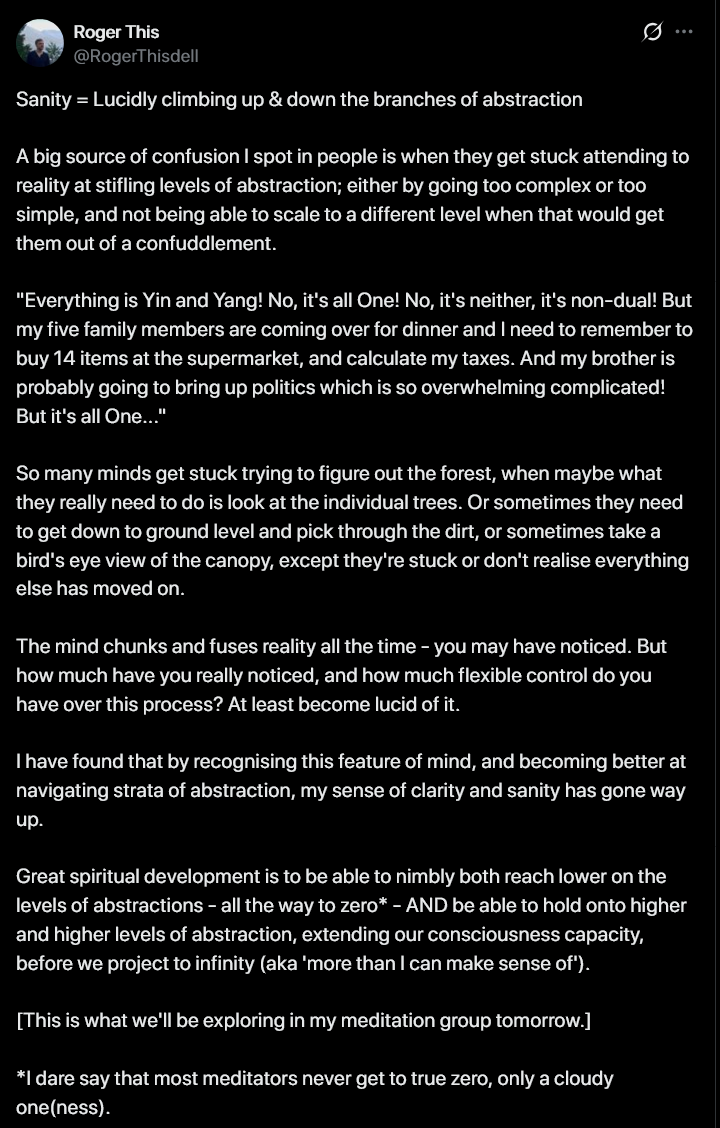
i also think this is what wisdom is. wisdom is not algorithmic because it is context dependent and generally explained by negation (don’t do X, not Y, etc). it’s pragmatically knowing when to switch abstractions to match what the moment is calling for.
burbea constantly reinforces the idea that all views are empty, even emptiness. learn to be flexible.

