It would not surprise me if coherence was another property that could be found in a mathematical representation of consciousness, alongside symmetry.
I was originally going to write about this in ‘Internal, then External’ but decided to leave it out.
As a metaphor, QRI states “You can liken your consciousness to a large canvas on which the brain ‘paints’ qualia to represent both sensory inputs and thoughts.” This metaphor is used to demonstrate pleasantness as a global property of the canvas in which qualia are painted on, almost acting as the “background.”1
Well it turns out, if qualia formalism (“[consciousness] can be described precisely by a mathematical object”) and structuralism (“this [mathematical] object has regularity and structure”) is true, valence could be found as an output of a property within the mathematical object of consciousness. This property is symmetry, the “[property] of this representation [that] will encode how pleasant the experience is.”2 This property should be universal and fundamental found across all experience, including “all conscious systems.” The Symmetry Theory of Valence proposes that valence is the phenomenal correlate of symmetry in this mathematical object.
But how do we get from observing valence universally across experience to equating it with symmetry? Well it turns out there’s a bunch of different reasons, including the consistent alignment of symmetry with pleasure across physical and mental projections (from auditory harmony and biorhythm coherence to brainwave resonance), and through examining the phenomenology of pain vs. bliss (suffering presenting as friction and symmetry-breaking, while high-valence feels smooth).
The key insight here is that valence is a fundamental dimension applicable across conscious experience, coloring qualia in such a way to be obviously known. And, this can be found in the structure of the mathematical object of consciousness through assessing symmetry.
Well, using similar logic, I believe coherence could be another universal phenomenological property found in experience that could be found in the same mathematical object of consciousness that symmetry is found in.
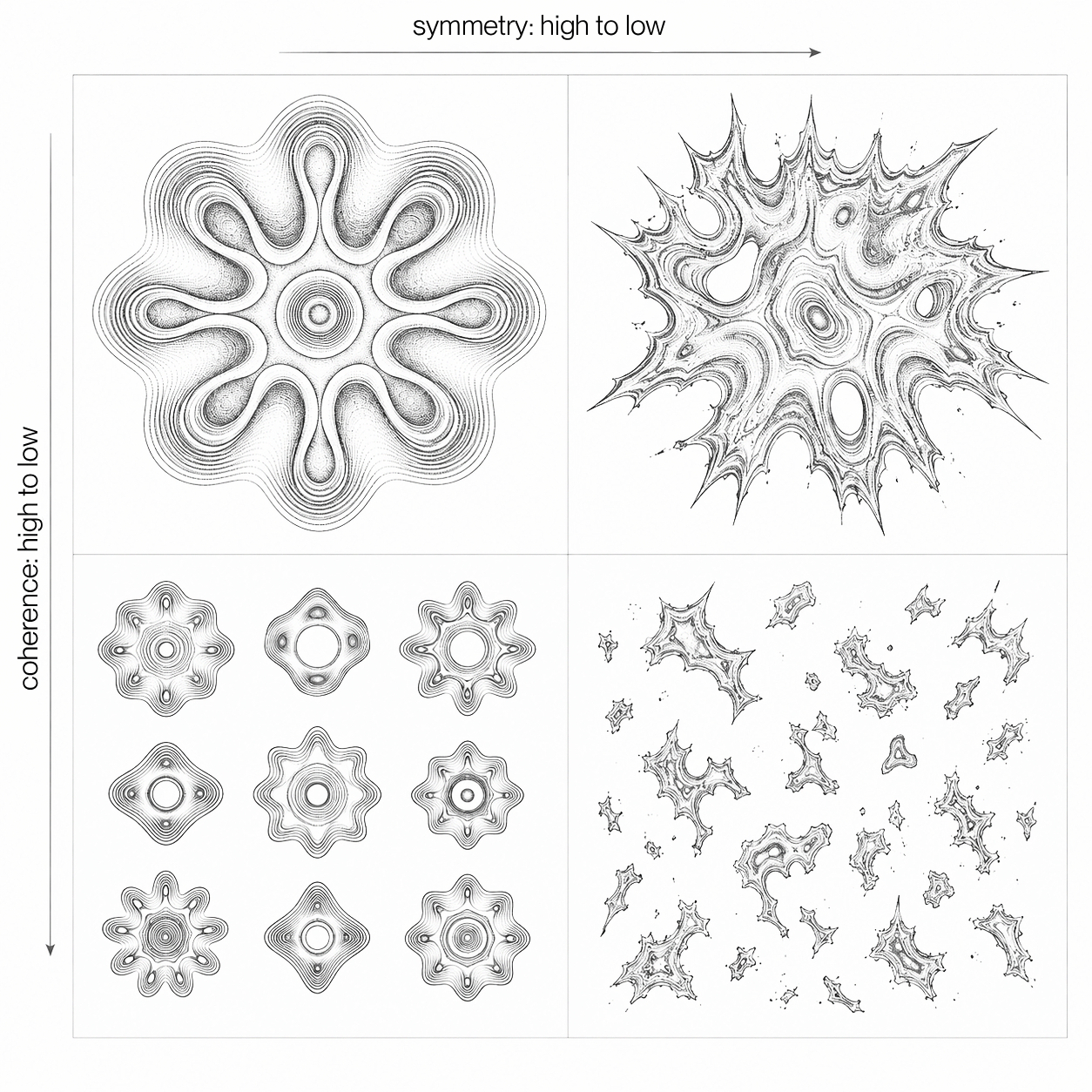
As a simplified representation for symmetry and coherence working together, see the image below:
I believe all experience can be “measured” through a lens of how unified or fragmented it appears. This is to be differentiated from attention itself, as attention more so corresponds with what is “being selected through negation” in experience, while coherence corresponds with how well foreground and background contents sit together as one organized state.
Coherence can be found across a multitude of examples describing subjective experience including jhana, samadhi in meditation, non-dual experiences, flow, fragmented psychological parts (eg within IFS framing), dissociative states, prayer (eg christian centering prayer3), and religious symbolic imagery. Because of this universality, I believe just as much as valence seems to color qualia within the canvas of consciousness, coherence influences how much of that painting is unified towards one singular picture.
Coherence might capture something not fully captured by symmetry: the compatibility of differentiated content fitting under one unified organization. If we think of experiences in which coherence would be high, like a flow state, we would not label content, like what we are working on and our actions, as being “incompatible.” When we phenomenologically attempt to bind these things together, they seem to fit neatly, jointly compressing without rubbing against each other.
Coherence importantly does not mean sameness. Individuation is still important, marking the boundaries between content in experience is what makes the property available at all. This gets interesting when you consider the skill of sensory clarity: individuating qualia in perception can present more coherence by making distinctions clear, if conflict between them decreases. Theoretically, if content is more differentiated by turning up the resolution of phenomenological space, compatibility could rise, as would coherence. “Fuzzy” or ambiguous parts of experience can make stable relations between parts harder to establish, reducing compatibility. This might be occurring in meditators when they report meditation (specifically jhana) can “smooth” experience out: qualia becomes “softer” and fits together better. Importantly this is, by nature, comparative. If we are judging a part of experience as soft or spiky, we are comparing it against other parts, sort of putting them together like puzzle pieces.
If we think of a state like a panic attack, coherence is high because content of the experience is mainly organized around terror and foreground and background sensations are unified and fit together well, while symmetry is very low due to extremely unpleasant valence. Comparatively, a state like “pleasant but scattered ecstatic” would have low coherence due to fragmented content that is clearly isolated in its texture, but high symmetry due to its pleasure.
It is also likely more coherent states correlate with higher degrees of symmetry because globally coordinated systems have fewer conflicting degrees of freedom, meaning parts could “mold into” symmetric states as to not cause friction. When we think of states with high coherence, we typically associate them with higher valence, like the flow state. Fragmented states, such as a felt sense of persistent dissociation or derealization, are often experienced as extremely low valence. This correlation can be found in coupled oscillator synchronization, where stronger attractive coupling can suppress independent organization and promote coordination,4 though the move towards symmetry is not established here.
It is also plausible that states of higher coherence might reduce demands on cognitive control of the adaptive system because less ongoing conflict resolution between parts is needed. If compatibility rises, there is less need for corrective effort, which increases felt ease and capacity. This would align with advanced meditators, like @nickcammarata,5 reporting that they experience increases in energy levels due to less “pulling and tugging” of felt experience.
There are two questions that are downstream of all of this. The first being, what “parts” exactly are supposedly being measured for compatibility? And the second being, what would represent coherence in the mathematical object of consciousness?
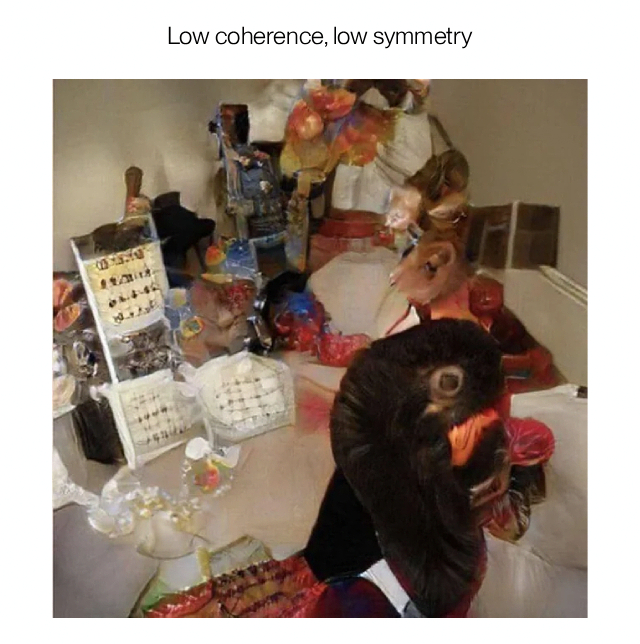
For the first question, I think it is possible to examine phenomenological perception and say gestalts are the different parts at play here. If you look at the image below, there are parts that clearly do not form expected gestalts. The image is presented to contain things that are unrecognizable, but the thing is, some things are clearly identifiable, like shapes and colors and vibes. But, these parts are clearly not very compatible, resulting in visual friction when our systems try to put these different parts together. I believe in states of low coherence, this is happening across experience, just in a form that is much more implicit and diffuse. Because the image is so low in coherence, there is no unifying organization driving the different parts to be compatible. And because there is no unifying organization, symmetry is much less likely to occur, which results in lower valence. Now, this does not tell us the formal structure driving these events in consciousness, but it’s still a pointer.
For the second question, I don’t really know, and I don’t intend to explore this since I’m not a mathematician and I would butcher the math, but I still believe this is a strong candidate property of consciousness alongside symmetry.
I also wouldn’t doubt if my definition of coherence is precisely wrong, or if coherence is not a singular scalar, but I still think it’s pointing to so me useful direction even if just metaphorical
